Daily Notes: The Simplest Note-Taking Habit That Actually Sticks
One dated note per day, everything in it. Why daily notes work when elaborate systems fail, and how to run the habit in under five minutes a day.
By corone · · Productivity · 6 min read
Most note-taking systems fail at the same place: the decision. Where does this thought go? Which notebook, which folder, which project? Every capture starts with a small act of information architecture, and under real-world pressure — mid-meeting, mid-commute, mid-idea — the architecture loses. The thought stays in your head, and then it doesn't.
Daily notes delete the decision. The system is one rule long: each day gets one note, dated, and everything from that day goes in it. Meeting fragments, ideas, tasks, links, complaints, the name of the restaurant someone recommended. No filing, no categories, no guilt. It is the rare productivity habit that works because it asks so little.
Why such a dumb system works so well
Zero-friction capture
The daily note is always the answer to "where does this go?", so capture becomes a reflex instead of a decision. This matters more than any other property of a note system: the best-organized archive in the world is worthless for the thoughts that never entered it.
Time is a surprisingly good index
We remember when things happened far better than we admit — "that was the week of the launch," "sometime just after the trip." A chronological record exploits that memory for free. Combined with full-text search, "roughly when + one keyword" finds almost anything.
A journal emerges as a side effect
People who cannot maintain a journal maintain daily notes without noticing. Scroll back three months and you have an honest record of what you were doing, deciding, and worrying about — written with no audience in mind, which makes it more truthful than any deliberately-kept diary.
It composes with everything else
Daily notes are not a rival to Zettelkasten, PKM, or project notes — they are the intake pipe. Capture lands in the daily note; anything worth keeping gets promoted later into a real, linked note. Every elaborate system runs better with a dumb inbox in front of it.
Running the habit: the mechanics
- Use bullets, not prose. A daily note is a log, and logs want an outline: one line per event or thought, details nested under the line they belong to. A meeting becomes one bullet with the discussion indented beneath it — collapse it and the day reads as a summary.
- Timestamp nothing, mostly. The date on the note is usually enough precision. Add times only when they carry meaning (calls, incidents).
- Mark tasks as tasks. Use your app's checkbox syntax for anything actionable so it can be aggregated later, instead of letting to-dos dissolve into text.
- Link names and projects as you type. If your tool supports
[[wiki-links]], linking "discussed pricing with[[Acme]]" costs two keystrokes — and via backlinks, the Acme note automatically accumulates a dated history of every mention. This is the quiet superpower of the habit: chronology and topic notes cross-index each other for free. - Lower the bar to the floor. A three-line day is a success. Blank days are allowed. The habit dies from perfectionism long before it dies from laziness.
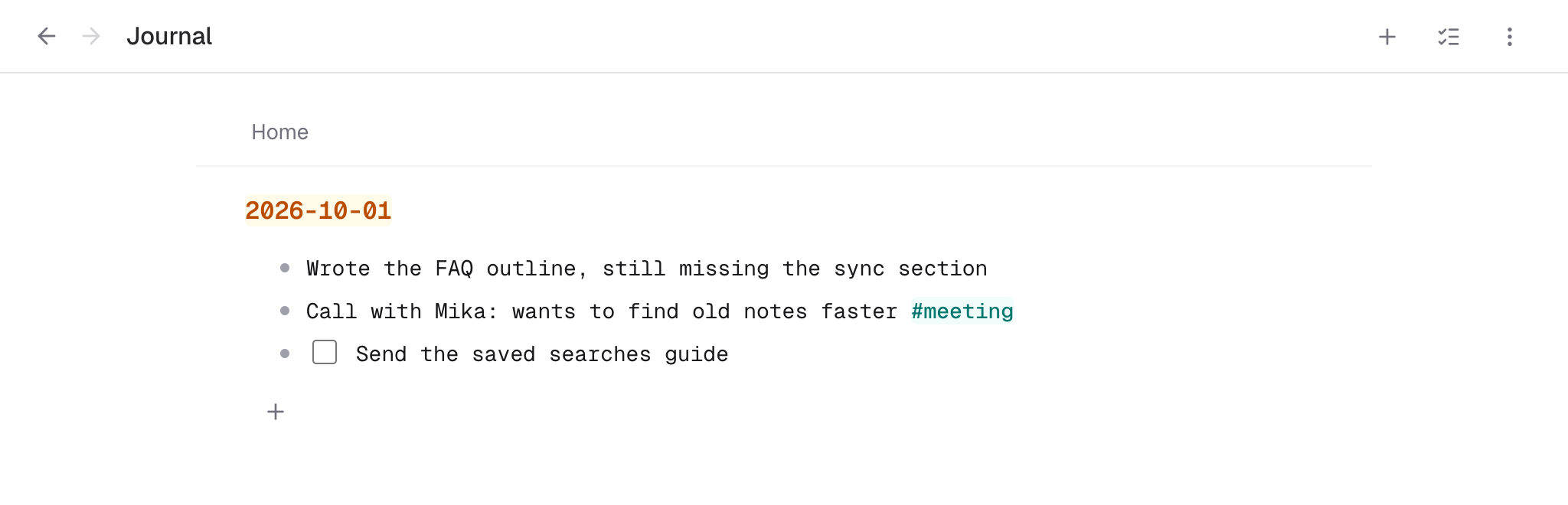
Indenta takes a slightly different shape than one note per date: the journal is a single note in which every day is a branch, so your note list never fills up with date pages. Ctrl/Cmd+Shift+J, or the pen icon on the Today row in the sidebar, jumps to today's branch, creating the Journal note the first time, and opens it zoomed in so it reads like a page of its own. The date is recognized as a date, #meeting is a tag, and a checkbox written under a day inherits that day as its due date:
The five-minute weekly sweep
Once a week, skim the week's notes and do three things: carry forward unfinished tasks, promote the two or three thoughts that still look valuable into proper topic notes, and move on. Resist the urge to reorganize history — the daily notes are the archive; promotion is for the exceptional items, not a transcription duty. Five minutes is the honest budget; if the sweep takes thirty, you are filing things nobody will retrieve.
Common objections, answered briefly
"Won't it become an unsearchable pile?" Only if your tool's search is bad. Date + keyword retrieval is robust in practice, and promoted topic notes catch the genuinely important material.
"I already have a task manager / journal / PKM." Keep them. Daily notes feed those systems; they don't compete with them. The daily note is where things land before you know what they are.
"I tried journaling and quit." Journaling asks for reflection in sentences; daily notes ask for fragments in bullets. The output looks similar after a year, but the daily cost is a tenth.
Starting today
Create a note titled with today's date and put one bullet in it. That is the entire setup. In Indenta the pattern is comfortable out of the box: the Quick Note is an always-open scratchpad for instant capture, dates get first-class date chips, checkboxes aggregate into a task view, and [[wiki-links]] plus automatic backlinks handle the cross-indexing — all offline, on your own device. The User Guide covers each piece. But the habit needs no particular software: one dated note per day, everything in it, five-minute sweep on Fridays. Start tonight; in ninety days you will have a record you would not sell.
Keep reading
- Interstitial Journaling: Timestamp the Gaps and Get Your Focus Back — A timestamped line between tasks costs ten seconds and buys back the context you lose at every switch. How interstitial journaling works, without ceremony.
- Note Templates: When They Help and When They Get in the Way — Templates promise consistency and speed, but the wrong one adds a filing chore to every capture. A practical guide to which notes deserve a template and which don't.
- The Weekly Review: The Habit That Keeps Notes From Becoming a Junk Drawer — Daily capture piles up loose tasks and stalled notes. A fifteen-minute weekly review catches what daily notes miss, without becoming a project of its own.
About the author: corone is a software engineer in Japan who builds Indenta and uses it every day as their own primary note system. More about who makes Indenta.
Try it in practice: Indenta is a free, offline-first outliner — nested notes, backlinks, tags, and peer-to-peer sync, with no account required. Start writing in your browser, or read the User Guide first.